Snow preparedness: orange for Upper Bavaria, Vienna, Lower Austria
On 26 November 2026 the DWD reports widespread frost, patchy fog and ice, with snowfall in the south-east and in Saxony overnight into Friday. Meteoalarm shows orange for snowfall in Upper Bavaria and for snow and ice in Vienna and Lower Austria. Here is what the authorities advise for daily life, t

Snow and ice: orange in Upper Bavaria and eastern Austria (as of Thursday morning, 26 November)
Germany's national weather service, the Deutscher Wetterdienst (DWD), describes widespread frost, patchy fog and ice in its warning situation report of Thursday 26 November 2026, 4:55 am. From late morning, snowfall spreads from the edge of the Alps into the southern and eastern foothills, with 3 to 10 cm of fresh snow in places. Up to 15 cm is possible on the edge of the Alps east of the River Inn. Overnight into Friday the snowfall eases, while Saxony gets light snow of 1 to 5 cm.
The feeds of Meteoalarm, the European weather warnings portal, showed orange for "Snow-ice" in both Germany and Austria this morning. In Germany, Thursday's orange covers snowfall in Upper Bavarian districts such as Bad Tölz-Wolfratshausen, Garmisch-Partenkirchen, Miesbach, Berchtesgadener Land, Traunstein and Rosenheim. Orange ice warnings for districts in Baden-Württemberg and Bavaria, such as Sigmaringen or Augsburg, applied only until Wednesday night. In Austria, the feed lists orange for Vienna, including all of its districts, among them Liesing, Donaustadt and Floridsdorf. Districts in Lower Austria, such as Baden, Mödling and Gänserndorf, are also included.
We have no figures on snow amounts for Austria, so it is not possible to say how much snow will fall in Vienna. Nothing is known about damage or accidents either. This article describes the warnings and gives you tips on how to prepare for them in daily life.
What the morning warning tables show
The DWD warning tables from Thursday morning (as of 6:25 am) list the following for Bavaria:
- Snowfall of 10 to 15 cm: Bad Tölz-Wolfratshausen, Garmisch-Partenkirchen and Miesbach (Thursday 7:00 am to 9:00 pm), plus Berchtesgadener Land, Traunstein and the district and city of Rosenheim (until Friday 1:00 am).
- Light snowfall of 1 to 5 cm for the district and city of Munich (Thursday 7:00 am to 9:00 pm). The snowfall warnings add: "It will become slippery in many places."
- Ice in many districts, for example Aichach-Friedberg, until Thursday 10:00 am.
- Light frost between 0 and -5 °C, and in isolated places moderate frost between -5 and -8 °C (for example Amberg-Sulzbach and Bad Kissingen), until Thursday 12:00 noon.
For Baden-Württemberg, the warning table shows ice and frost warnings this morning. Frost is mostly between -1 and -5 °C, and some of the warnings cover a risk of ice above 400 m, but there is no snowfall warning.
What happens next
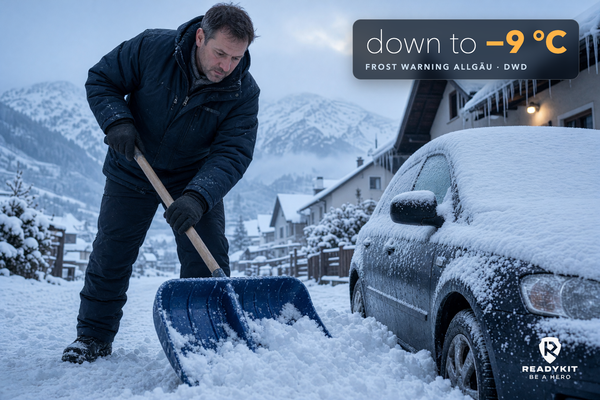
According to the DWD's Topic of the Day for 25 November, low-pressure system "Xela" is moving east from France across northern Italy. On Thursday the heaviest precipitation is in the south-east, where it may snow at times. Snow grains or freezing drizzle are also possible in places. The DWD expects frost all day in some areas, especially on Thursday and Friday. Where skies stay clear for longer, night temperatures fall below -5 °C in places and as low as -9 °C in isolated spots.
Precipitation dies down on Friday, and Saturday is expected to stay dry. By Sunday a trough of low pressure approaches from the north-west and could bring some rain, freezing rain or snow. According to the DWD, it is still uncertain how much precipitation will fall and how far south-east it will reach. At the start of next week temperatures are expected to rise slightly, but nights stay frosty.
What this means for you
On paths and roads, ice is the main concern. For the morning, the late morning and the night into Friday, the DWD mentions isolated ice from re-freezing and freezing fog deposits. In places there is also dense fog with visibility below 150 m.
Germany's Federal Office of Civil Protection and Disaster Assistance (BBK) also points out that heavy snowfall and icing can damage power lines. Nothing of the kind has been reported for this situation. Still, it is a good moment to check what works in your home without electricity.
What to do in snow and ice
Beforehand
- Keep an eye on weather warnings for snowfall and ice, for example in the NINA warning app (Germany). During a power cut or a mobile network failure, many warning channels do not work, according to the BBK. A radio that does not run on mains power will still help.
- If you can, stay at home when there are warnings of heavy snowfall and ice. With a stock of food and drink, you can skip shopping on days like these (BBK).
On the move
- Heavy snowfall and ice can be dangerous for everyone on the road, whether on foot, in a car or on a bike. The BBK advises taking care to avoid accidents and falls.
- If you witness an accident or a fall with injured people, give first aid and call the emergency number.
- Car: the authorities this article draws on do not say what winter equipment belongs in a vehicle, so we leave out specific lists. The only things on record are that car radios and wind-up radios work in a power cut because they do not need power from a socket, and that a power bank lets you charge your phone.
At home and with children
- Snow can slide off roofs, and icicles often hang from gutters and can break off. The BBK advises keeping a safe distance from sloping roofs.
- Warn children that when snow turns icy and hard, it can cut their hands while they play. Hard snowballs can also cause serious injuries.
- Only step onto ice once it has been cleared for use. The BBK gives a layer of at least 15 cm as the requirement, and local authorities open suitable areas. The German Life Saving Association (DLRG) advises never going onto ice alone, stepping onto a lake only from 15 cm of ice and onto flowing water only from 20 cm, and leaving the ice at once if it creaks and cracks. If someone falls through, call the fire brigade on 112.
Emergency numbers
- Germany: 112 and 110. The BBK lists both as emergency numbers.
- Austria, according to oesterreich.gv.at (the Austrian government portal): fire brigade 122, police 133, ambulance 144, European emergency number 112, out-of-hours doctor 141, mountain rescue 140.
- For Austria, the site gives the "4 Ws" for an emergency call: Where did it happen? What happened? How many people are injured? Who is calling? Wait for any questions.
Preparing at home: supplies, light and warmth
The BBK recommends that every household should be able to look after itself for 10 days if possible. Supplies for at least 3 days already help a great deal, and you can build on that step by step. The Austrian site oesterreich.gv.at gives no number of days but also advises keeping supplies in case you cannot leave the house for a longer time. The BBK adds that every bit of preparation is worthwhile.
- Food: the BBK names three criteria: it keeps without refrigeration, it needs no cooking, and it cooks quickly. The Austrian site advises food you can also eat cold in an emergency.
- Water: ideally 2 litres per person per day, of which 0.5 litres is for cooking. For 3 people and 3 days, that comes to 18 litres.
- Light: a torch with spare batteries, candles and a lighter.
- Warmth: warm clothing, blankets and sleeping bags can bridge a heating failure for a while. Keep windows and doors closed, but ventilate regularly by opening the windows wide for a few minutes (BBK).
- Cooking and heating without electricity: indoors, use only appliances approved for that purpose. According to the BBK, camping stoves with gas cartridges and barbecues belong outdoors only. Too little oxygen can produce carbon monoxide, which can be fatal. The BBK recommends tested carbon monoxide alarms.
- Information: a warning app, a battery-powered or wind-up radio, a paper list of important phone numbers and a power bank.
- Documents and medication: important papers in a folder, your personal medication and first aid supplies. According to oesterreich.gv.at, you should also have cash and know where the main switch for electricity and the shut-off valves for gas and water are in your home.
A backpack for when you have to leave
If you would like a 72-hour kit, there are two ways to get one. With the ReadyKit configurator you can build your own emergency backpack to suit your needs. Or you can choose the pre-packed emergency backpack, designed for 72 hours of self-sufficiency. The electronics module includes a wind-up radio and a solar power bank, among other items. That matches the recommendations above: a radio that does not need mains power, and a power bank. The shop recommends checking the backpack once a month: the shelf life of food and medication, batteries, electronics and documents.
In short
Thursday is about snow, ice and frost, and for Sunday the DWD says it is still open whether rain, freezing rain or snow will arrive. A warning app, a torch and a few litres of water are quickly bought and will help you if the power goes out. For what comes next, check the latest warnings from the DWD and Meteoalarm.
BE A HERO – Because your family is counting on you.
Sources
- Warning situation report for Germany, 26.11.2026, 4:55 am, German Weather Service (DWD)
- High-pressure influence with clear flaws (Topic of the Day, 25.11.2026), German Weather Service (DWD)
- Warning table Bavaria, as of 26.11.2026, 6:25 am, German Weather Service (DWD)
- Warning table Baden-Württemberg, as of 26.11.2026, 6:25 am, German Weather Service (DWD)
- Meteoalarm feed Germany, retrieved 26.11.2026
- Meteoalarm feed Austria, retrieved 26.11.2026
- Preparing for and acting in cold and snow, BBK
- Preparing for crises and disasters, BBK
- Self-protection in a disaster, oesterreich.gv.at