Flooding in France: orange warning on the Côte d'Azur
For Wednesday 25 November 2026, Var and Alpes-Maritimes are under an orange "vigilance" warning for rain and flooding. This is what the warning means and what French and German authorities advise for heavy rain and flash floods.

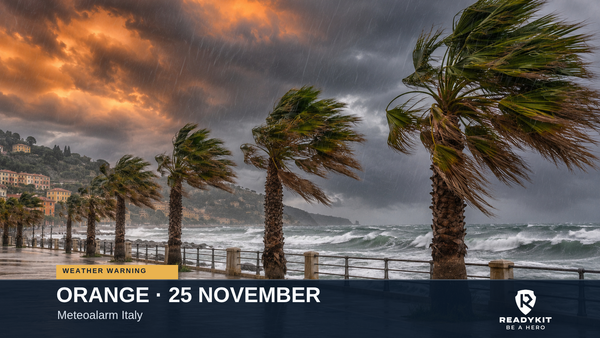
Orange for Var and Alpes-Maritimes on 25 November (as of Wednesday morning)
In its bulletin of 16:00 on Tuesday 24 November 2026, Météo-France put the départements (French administrative districts) of Var and Alpes-Maritimes on "vigilance orange" for "pluie-inondation" on Wednesday 25 November. That means rain with a risk of flooding. franceinfo and L'Indépendant both report it. The warning starts at midnight and runs until 22:00 (ici). The Meteoalarm feed for France also listed both départements as orange at 06:00 on Wednesday morning.
According to Météo-France, this is a Mediterranean episode that calls for particular attention because of the expected rainfall totals, and it comes at a time when the ground is wet (our own translation from the French bulletin). This article describes warnings, not damage. If you are in the region today or have relatives there, the current map is on the Météo-France site.
What Météo-France expects
- Amount: over a little more than 24 hours, Météo-France mostly expects 70 to 90 mm of rain, locally 120 to 150 mm. According to Le Figaro (AFP), that is up to 150 litres per square metre.
- Timing: the heaviest rain falls overnight and in the morning, at 20 to 30 mm an hour. It eases around midday, returns more moderately in the afternoon and ends in the evening.
- Where: in Var, the coastal zone and the area from Sainte-Baume to the Estérel across the Maures; in Alpes-Maritimes, the Côte d'Azur and the Alpine foothills around Grasse (source: Le Figaro and L'Indépendant).
- Ground: according to Météo-France, the soil is already saturated. That favours run-off over the surface and a quick response from streams and rivers.
- Spread: Météo-France does not rule out extending orange to other départements, such as Bouches-du-Rhône, Vaucluse, Drôme or Alpes-de-Haute-Provence. It says this is not the preferred scenario.
According to Nice-Matin, quoted by L'Indépendant, this would be the sixth Mediterranean episode of the autumn.
The Meteoalarm feed also shows a second orange warning for Var, for river flooding ("flooding"): major flooding is possible, embankments may be damaged or overtopped, and power cuts may occur. It applies on Wednesday and still on Thursday 26 November. So according to the feed, the flood warning for Var runs beyond Wednesday. Vigicrues, the state flood-monitoring service for rivers, showed orange as the highest level in mainland France on its home page on the morning of 25 November (national bulletin of 05:45): one river stretch in orange, 14 in yellow. The archived page text does not say where the orange stretch is.
What "orange" means
According to Météo-France, orange "pluie-inondation" can bring, among other things:
- major flooding in areas that are prone to flooding anyway,
- unusual rises in streams and ditches after short, very intense downpours,
- overflowing drains,
- difficult road conditions, especially on minor roads, and isolated disruption to rail services away from the high-speed lines,
- power cuts.
Why this concerns you too
According to the French portal Géorisques, flooding is France's number one natural risk, with 18.5 million people exposed. Flash floods ("crues éclair") are especially dangerous: the level of a river or stream can rise by several metres in less than two hours, and just 30 cm of water can carry a car away. Géorisques gives Vaison-la-Romaine in 1992, the Aude in 1999 and the Alpes-Maritimes in 2020 after Storm Alex as examples.
The subject is not far from home either. Germany's Federal Office of Civil Protection and Disaster Assistance (BBK) writes that flash floods can occur anywhere in Germany, whether or not a stream is nearby. Even a gentle slope can channel water towards a building, and in dips and underpasses the water level can rise quickly in a cloudburst.
What to do
Wherever you are, follow the advice of that country's authorities. In France that means Météo-France and Géorisques. The points below come from their recommendations, supplemented by the BBK.
Before a journey and on the road
- Before you travel, check the warning level with Météo-France and the river status with Vigicrues. According to its own site, Vigicrues publishes information at least twice a day, at 10:00 and 16:00.
- Météo-France advises avoiding journeys under orange. Géorisques recommends postponing all trips, on foot or by car, when flooding has been announced and the water is rising.
- Do not drive onto a flooded road, even if it is only partly flooded. The BBK adds that underground car parks can become deadly traps when flooding threatens. If a vehicle is standing in water above its wheels, have it towed.
- Keep away from rivers, banks, bridges and low-lying spots.
Indoors
- Move to higher ground or go to an upper floor. Géorisques recommends going upstairs with your 72-hour kit.
- Do not go into cellars or underground car parks. The BBK writes: staying in the cellar during a flood is life-threatening.
- Switch off electricity, gas and heating if you can. The BBK points to the risk of electric shock and recommends switching appliances off in rooms that could flood, and if need be turning the power off altogether (take out the fuse).
- Move valuables and anything that must not get wet to a high place. According to the BBK, store items in waterproof containers.
- Keep an eye on the situation via Météo-France and Vigicrues.
Outdoors and with children
- Géorisques expressly advises not to collect children from school or nursery when flooding has been announced and the water is rising: they are safe there. The BBK advice to bring children out of the flood area before the danger arrives refers to the time before the event. In France, the French recommendation applies.
- Do not enter riverbank areas, where there is a risk of undercutting and collapse (BBK).
- Help others, but do not put yourself in danger (BBK).
Evacuation, emergency calls, phone use
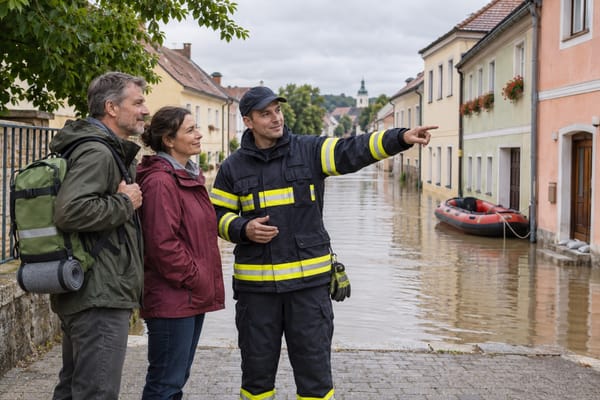
- According to Géorisques, leave your home only when the authorities order it, and follow their instructions. The BBK adds: follow the emergency services' instructions and respect their cordons.
- In an emergency, call 112, the single European emergency number, to reach the emergency services. According to Your Europe, it is free in all EU countries, including from a mobile.
- Otherwise avoid phoning where possible, so that the networks stay free for the emergency services (Géorisques, BBK).
Afterwards
After a flash flood, the BBK recommends the following: check the building for damage, dry affected areas quickly, have any structural damage, heating-oil tanks and electrical appliances checked by a specialist, photograph the damage and inform your insurer. If pollutants such as heating oil have got into the house, call the fire brigade straight away.
Preparing at home
From the recommendations of Géorisques and the BBK:
- Ask your local authority (in France, the mairie) which kind of flooding is possible where you live and where shelter is available in an emergency (Géorisques).
- Have a non-return valve fitted and check your household drains regularly (BBK).
- Get sandbags, waterproof plywood boards and silicone for sealing doors and windows (BBK). Géorisques also mentions mobile barriers (flood boards) and materials for raising furniture.
- Plan a refuge on an upper floor with an opening you can get out through, or find a place nearby (Géorisques).
- Store hazardous substances away from areas at risk of flash flooding (BBK).
- Keep an emergency kit ready for 72 hours (Géorisques). What exactly belongs in it is on the Géorisques page "Mon kit d'urgence 72H", which we have not reproduced here.
- If you live in Germany, subscribe to your home and workplace locations in the BBK's NINA warning app. According to the BBK, the app carries weather warnings from the German Weather Service (DWD) and flood information from the federal states.
If you would like to get a 72-hour kit, there are two ways. In the ReadyKit configurator you build your emergency backpack to suit your needs. Or you can take the pre-packed emergency backpack, which is designed for 72 hours. The electronics, hygiene items and sleeping module are packed waterproof inside, and there are waterproof bags for documents and spare clothes. The backpack itself is water-repellent, but not waterproof.
Stay calm, stay informed
The orange warning for Var and Alpes-Maritimes runs until Wednesday evening, and according to Meteoalarm the flood warning for Var remains in place until Thursday. Check the warning level with Météo-France before you set off, and postpone journeys if you can.
BE A HERO – Because your family is counting on you.
Sources
- Le Var et les Alpes-Maritimes placés en vigilance orange mercredi pour "pluie-inondation", franceinfo (24.11.2026)
- Verglas dans le nord, pluies orageuses dans le sud-est: la météo du mercredi 25 novembre, Le Figaro / AFP (24.11.2026)
- Jusqu'à 150 mm de pluie attendus: le Var et les Alpes-Maritimes en vigilance orange, L'Indépendant (24.11.2026)
- Météo : les Alpes-Maritimes et le Var en vigilance orange pour "pluie-inondation", ici (24.11.2026)
- Vigilance météo Alpes-Maritimes, Météo-France
- Warnings for France, Meteoalarm feed (retrieved 25.11.2026), Meteoalarm / Météo-France
- Vigicrues: Carte de vigilance crues, Vigicrues (bulletin of 25.11.2026, 05:45)
- Inondation, Géorisques (Ministère de la Transition écologique / BRGM)
- Que faire en cas d'inondation ?, Géorisques (Ministère de la Transition écologique / BRGM)
- What to do in a flood (BBK guidance, in German), BBK
- Naturgefahr Starkregen (Natural hazard: heavy rain, in German), BBK
- Warn-App NINA (NINA warning app, in German), BBK
- Single emergency number 112, Your Europe (European Union)