When the water rises: how the right response to a flood saves lives
Extreme weather is on the rise and flood protection is moving up the agenda. Germany and Austria have already seen devastating floods, including the 2021 Ahr valley disaster with more than 180 deaths. Experts warn that knowing how to act in an emergency can be what keeps you alive.

Extreme weather is becoming more common, and flood protection is moving steadily up people's list of concerns. Germany and Austria have already been hit by devastating floods, among them the 2021 disaster in the Ahr valley, which claimed more than 180 lives. Experts point out that solid knowledge of how to act in an emergency can be what keeps you alive.
A danger people underestimate
Floods are among the most common natural disasters in the world. They have several causes: prolonged rain, snowmelt, storm surges or, most devastating of all, tsunamis set off by undersea earthquakes. Germany's Federal Office of Civil Protection and Disaster Assistance (BBK) points out that the threat from heavy rainfall, and from the flash floods it brings, is growing, particularly in densely populated areas.
History shows how bad it can get. The most severe flood in recent history struck China on 26 August 1931. Four million people lost their lives and 40 million were left homeless. In all, 330,000 hectares of land were under water, and hunger and disease killed a further 3.7 million people.
Act on early warnings: every second counts
Modern science can now forecast floods far more accurately on the basis of meteorological factors. Hydrological centres and civil protection authorities are able to warn people in good time. Austria uses its AT-Alert system for this, while Germany relies on Cell Broadcast alerts and apps such as NINA, its official emergency information and news app.
How people react to those warnings is what counts. Panic is the biggest enemy here. If you keep a cool head, you can save your own life and the lives of others when it matters most. Experts recommend agreeing meeting points with family and neighbours ahead of time and planning your evacuation routes.
Preparation is key
Thinking ahead can save lives in a real emergency. In its current emergency preparedness guide, the BBK recommends always keeping a supply of food and drinking water for at least three days. Just as important are documents packed in waterproof covers, any medication you need and a working torch with batteries.
If you live in an area at risk, store valuables on upper floors or in the loft as a precaution. Before the floodwater arrives, you must turn off the gas, electricity and water to prevent further damage from fires or short circuits.
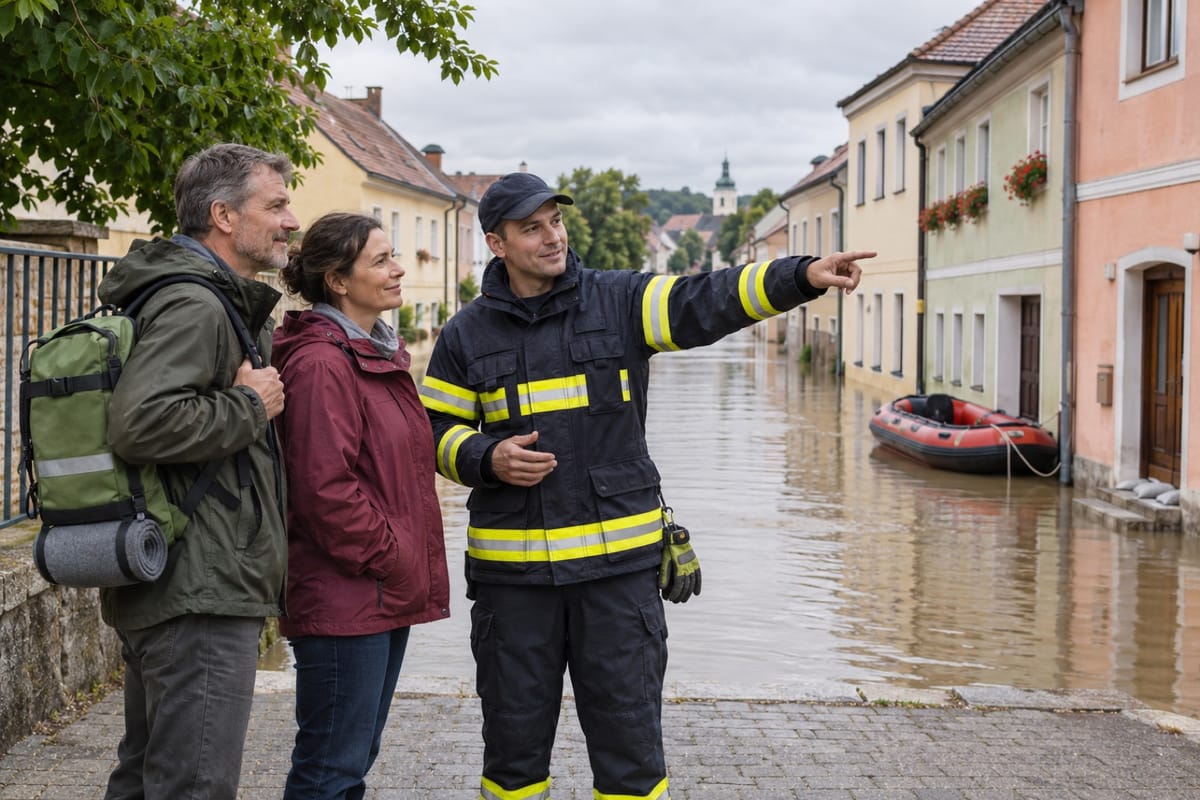
Personal protective equipment deserves special attention. In flood areas, the right safety gear can mean the difference between life and death. If you end up in the water, buoyant items such as inflatable cushions, a life jacket with impact protection or, as a last resort, air-filled plastic bottles tucked into your clothing can act as improvised flotation aids. That said, specialists advise keeping proper emergency equipment close at hand, and it can be stowed in a well-stocked emergency backpack.
When the water arrives: what to do
If a flood catches you by surprise, there are clear rules to follow. If you are inside a building, go to the upper floors straight away and stay there until the emergency services arrive. Never use the lift, as it can turn into a deadly trap.
Signal for help from the roof or from other highly visible spots: with bright cloths during the day, and with torches or mobile phones at night. Once you are safe, let the rescue services know where you are so that nobody launches a search that isn't needed.
If the flood catches you outdoors, get to higher ground as quickly as you can. Austria's Civil Protection Association (Zivilschutzverband) strongly warns against wading through moving water. In a strong current, water just 15 centimetres deep can be enough to knock an adult off their feet.
If the current sweeps you away, experts advise lying on your back with your feet pointing downstream and looking for something solid to hold on to. Watch out for power lines in the water: they may still be live, and that puts you in immediate danger of a fatal electric shock.
The particular threat of tsunamis
Tsunamis are even more dangerous. These huge waves, triggered by undersea earthquakes or volcanic eruptions, can race across the ocean at up to 800 kilometres per hour and push as far as four kilometres inland.
A tsunami gives clear warning signs. If the sea suddenly pulls back a long way and exposes the seabed, there are often only a few minutes left to get away. Animals behaving strangely can also be a sign: they become restless, gather in groups or look for shelter.
On the coast, a tsunami warning means one thing above all else: get inland or up onto high ground. Every second counts. People's lives take absolute priority over possessions. Children, older people and anyone who is ill are especially at risk and need extra help during an evacuation.
If you can't get inland in time, take refuge on the top floors of a sturdy building with several storeys. As a last resort, tall trees can also offer protection, although debris carried along by the water is a real danger there.
After the flood: take care
The danger doesn't end when the water goes down. Buildings may be structurally damaged, and gas pipes and power lines may be broken. Flooded rooms should be checked thoroughly before anyone goes in, ideally by a professional.
The BBK recommends having electrical appliances and heating systems checked by specialists before you switch them back on. Contaminated drinking water is a serious health risk and should be boiled or disinfected before you drink it.
Rebuilding after a disaster works best as a joint effort. Time and again, neighbours helping neighbours and a strong sense of solidarity have proved decisive for a quick recovery. The Ahr valley in 2021 showed very clearly how much a close-knit community matters.
Community as a survival strategy
One point that often gets too little attention in public debate is how much social ties matter in a crisis. Disaster researchers note that in historical floods, high death tolls were often caused by a lack of cooperation and mutual help rather than by the force of nature itself.
The devastating earthquake in Haiti in 2010, which killed more than 222,000 people, is a tragic example. Many of the victims were not killed directly by the quake, but in the clashes over resources that followed and through a lack of mutual support.
In short: knowing what to do keeps you safer
As extreme weather becomes more frequent, personal emergency preparedness matters more and more. If you know the warning signs, act in time and keep a cool head, you greatly improve your chances of survival. Knowing what to do yourself is only part of it, though. Being willing to help others in need counts just as much.
The advice from authorities such as the BBK and Austria's Civil Protection Association is clear: prepare, stay informed and look out for one another. In the end, it is our humanity that makes the difference when disaster strikes.
Sources and further reading:
- Germany's Federal Office of Civil Protection and Disaster Assistance (BBK) - Guide to emergency preparedness and what to do in an emergency: bbk.bund.de/DE/Warnung-Vorsorge/Sicherheit-durch-Vorsorge/Materialien-Hochwasser/materialien-hochwasser.html
- Germany's Federal Office of Civil Protection and Disaster Assistance (BBK) - Preparing for and responding to floods: bbk.bund.de/DE/Warnung-Vorsorge/Vorsorge/Mit-Naturgefahren-umgehen/Hochwasser/hochwasser_node.html
- Austrian Civil Protection Association (Zivilschutzverband Österreich) - Flood guide and safety rules: zivilschutz.at/thema/hochwasser/
- Austria's official government portal - What to do in a flood: oesterreich.gv.at/de/themen/notfaelle_unfaelle_und_kriminalitaet/katastrophenfaelle/1/Seite.29500323
- Austria's official government portal - Protecting yourself in a disaster: oesterreich.gv.at/de/themen/notfaelle_unfaelle_und_kriminalitaet/katastrophenfaelle/1
- Austrian Federal Ministry of the Interior - National Crisis and Disaster Protection Management (SKKM): bmi.gv.at/magazin/2024_11_12/05_SKKM.aspx
- German Committee for Disaster Reduction (DKKV) - Governance and crisis communication during the July 2021 floods, DKKV publication series no. 63 (2024): dkkv.org/wp-content/uploads/2024/01/HoWas2021_DKKV_Schriftenreihe_63.pdf
- NOAA National Centers for Environmental Information - Haiti earthquake 2010: ngdc.noaa.gov/hazel/view/hazards/earthquake/event-more-info/8732
- Center for Disaster Philanthropy - Earthquake in Haiti 2010: disasterphilanthropy.org/disasters/earthquake-in-haiti/
- Britannica - Yangtze River floods 1931: britannica.com/science/Yangtze-River-floods
- DisasterHistory.org - Central China flood 1931: disasterhistory.org/central-china-flood-1931