Italy weather warning: orange for wind, rain and storms on 25 November
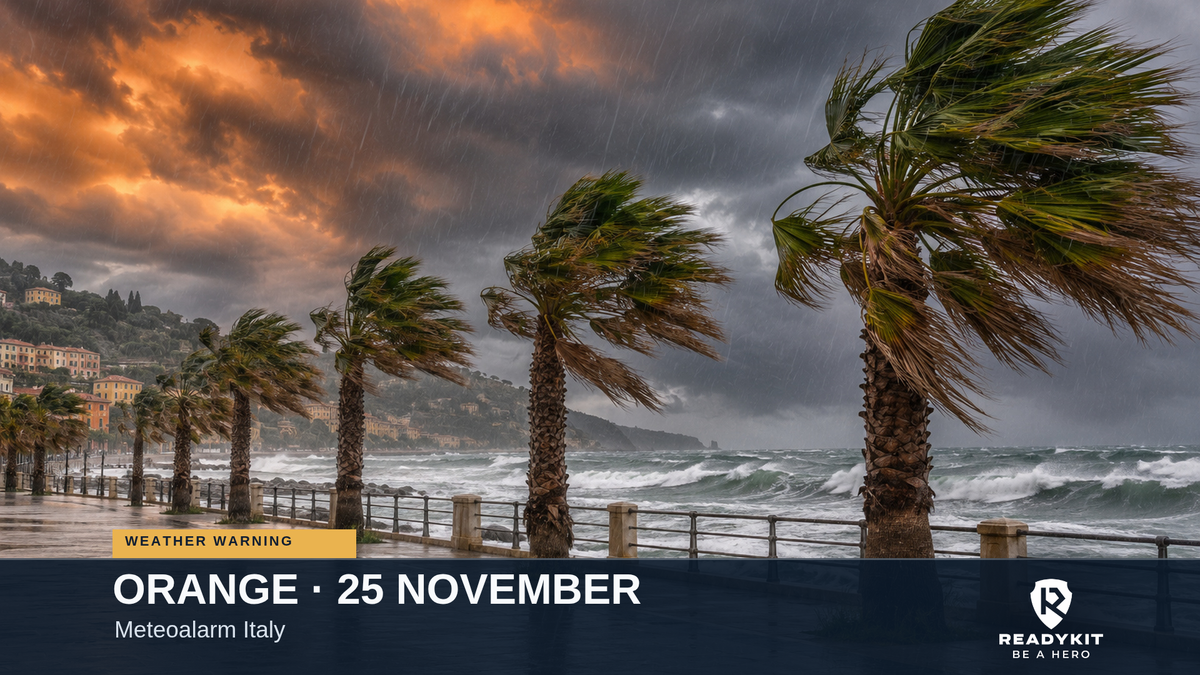
For Wednesday 25 November, Meteoalarm reports orange for wind, rain and thunderstorms in parts of Italy. Here is how to read the warnings and what civil protection, Germany's BBK and the German Foreign Office advise.

Orange warnings for Wednesday 25 November
The Meteoalarm warning feed for Italy lists several orange warnings for Wednesday 25 November 2026. They were issued on 23 November, and the feed was last updated at 05:05 UTC on 24 November. The times in it are given in UTC, which differs from local time, so check them for where you will be.
Orange applies to these regions:
- Campania: wind and rain from 00:00 to 22:59, thunderstorms from 00:00 to 17:59
- Lazio: wind and rain from 00:00 to 22:59, thunderstorms from 00:00 to 17:59
- Tuscany: wind and rain from 09:00 to 22:59, thunderstorms from 09:00 to 17:59
- Liguria: wind and rain from 00:00 to 22:59
- Calabria: thunderstorms from 00:00 to 22:59
- Basilicata: thunderstorms from 18:00 to 22:59
The feed also lists yellow for other regions, including wind and rain in Umbria, Marche and Emilia-Romagna, and snow and ice in the north.
For today, 24 November, the home page of Italy's civil protection service lists no significant meteo-hydrological phenomena.
Meteoalarm and civil protection are two different sources
The orange levels above come from the Meteoalarm feed. The official alert colours of Italy's civil protection service (Protezione Civile) come from a separate bulletin. The Bollettino di Criticità pulls together the regions' assessments and uses yellow, orange and red for ordinary, moderate and high criticality. An orange message on Meteoalarm is therefore not the same thing as an orange allerta from civil protection.
The bulletin that was online when we looked on 24 November is dated 23 November, 14:31. It runs to 24 November and lists no allerta for that day. The sources do not yet say which allerta colours civil protection will issue for 25 November, so we do not name any. Check the Allertamento meteo-idro page yourself to see whether a new bulletin has appeared.
What this means if you are travelling in Italy
Germany's Federal Foreign Office (Auswärtiges Amt) says in its travel and safety advice for Italy (as of 24 November 2026, unchanged since 18 November 2026): heavy rain and other extreme weather can cause flooding and landslides, and with them disruption to traffic, above all in the summer months. Extreme weather can also flood large cities such as Rome. In the Mediterranean, severe storms known as medicanes can occur, mainly in late summer, autumn and winter. Flooding, landslides and considerable traffic disruption are possible then too.
For travellers, the Foreign Office says: Meteoalarm provides current weather warnings. In an emergency, call the European emergency number 112, and you can be located straight away. Elsewhere, in its advice on volcanoes and wildfires, it also recommends always carrying your mobile phone and keeping it fully charged. If the Italian state declares a state of emergency because of weather damage on a large scale, follow the instructions of civil protection and the local authorities without fail. For a storm warning, the Foreign Office points to the advice of Germany's Federal Office of Civil Protection and Disaster Assistance (BBK).
On IT-alert: according to the Foreign Office, Italy's warning system sends messages to all switched-on mobile devices in a danger zone. The Office mentions it for volcanic activity at Vesuvius and in the Campi Flegrei. The archived sources do not say whether or when it is used for storms. The IT-alert page states plainly that IT-alert alone is not enough. Find out about the risks where you live, work or travel.
How to respond
Civil protection points out that the place and time of thunderstorms usually cannot be predicted in detail. Where and when flooding will happen can also be hard to say. For 25 November, the sources say nothing about whether or where it will happen. The rules below come from civil protection and the BBK.
Beforehand, while a warning is in force
- Keep up to date on the situation and on the measures taken by your municipality. According to civil protection, knowing whether the area where you live, work or are staying is prone to flooding helps you judge the risk.
- Do not sleep or stay in a basement or lower ground floor. If you have to travel anywhere, check the route first and avoid places that could flood.
- Think carefully before moving your car to safety. Civil protection says this can be dangerous.
- The BBK gives the main rule for a severe weather warning as: stay at home. Postpone appointments, do any urgent errands before it starts, and secure loose items outdoors such as bicycles and garden furniture.
- Fix down anything on your balcony or windowsill that the wind could carry off (civil protection).
- On the coast, strong wind brings the risk of heavy seas and high breaking waves (Italian: mareggiate), especially when the wind blows straight onto the shore. Take particular care on the shore and on coastal roads, do not linger there, least of all on piers and jetties, and do not swim or go out in boats.
In a storm or thunderstorm
- Do not stay outdoors in severe weather. Avoid woods above all: loose branches, falling trees and falling roof tiles make the risk of injury too great (BBK).
- If you hear thunder, even if it sounds far away, civil protection says the storm is only a few kilometres off or closer. Find shelter at once. No place outdoors is safe: go into an enclosed building and wait at least 30 minutes after the last thunder before going back outside.
- If there is no building, shelter in a car with the doors and windows closed. Keep away from isolated tall trees and poles and from water. At the seaside, that means: get out of the water and away from the shore.
- Indoors: switch appliances off at the mains, or better still unplug them. Do not touch metal parts that lead outside, such as wires, cables and pipes. Put off showers and washing up, which usually means an hour or two. Stay away from doors and windows, and close the windows.
- At the wheel: in heavy rain the road surface is slippery and visibility is badly reduced. Slow down or wait at a rest area. According to civil protection, the strongest phase rarely lasts longer than half an hour. Gusts can make vehicles skid, particularly at tunnel exits and on viaducts. Wind can even push vans, tarpaulin-sided lorries and caravans sideways.
In heavy rain and flooding
- Indoors: do not go into a cellar, a lower ground floor or a garage to rescue belongings. Civil protection warns that you risk your life. Under no circumstances go outside to secure your car. If you are in a basement or on the ground floor, go upstairs, and do not take the lift, as it can get stuck. Help older people and people with disabilities in the building.
- Switch off the gas and the electricity. Do not touch electrical appliances with wet hands or feet. Do not drink tap water, as it may be contaminated. Keep mobile phone calls to a minimum, because free lines help the rescuers.
- Outdoors: leave flooded areas. Even a few centimetres of fast-flowing water can knock you off your feet. Go to the nearest higher ground, but not towards slopes or artificial embankments that could give way.
- Avoid underpasses, flood banks and bridges. It is better to leave the car where it is: even a few centimetres of water can make you lose control or stall the vehicle, and you risk being trapped.
Afterwards
- Wait for the authorities' guidance before you go back into the house or clear mud and water out of the cellar.
- Do not walk or drive along flooded roads. There may be holes, open manhole covers and broken power cables, and the water may be contaminated by fuel.
- Check whether you can switch the gas and electricity back on. If in doubt, ask a professional.
- Drink tap water only once no order or notice from the municipality says otherwise. Do not eat anything that came into contact with the floodwater, as it may be contaminated.
Preparing at home
According to the BBK, severe weather, especially major storms, is usually forecast a few days ahead. Some preparations take time, so you should do them even when no warning is in force. The BBK lists:
- a supply of food and drink that you build up bit by bit. When a severe weather warning is out, you should avoid leaving the house if you can, even to shop
- a home medicine cabinet, so that you do not have to go to the chemist during storm warnings
- a battery-powered radio and torches, in case falling trees damage power lines, plus plenty of spare batteries
- an emergency kit and a folder of documents, in case you have to leave home quickly because buildings are damaged or heavy rain causes flooding
- photos of your belongings, which can help with an insurance claim if there is damage
Italian civil protection likewise advises keeping copies of your documents, a first aid kit, a torch and a radio with batteries. Everyone in the family should know where they are.
For severe weather warnings the BBK also names the warning app NINA. In it you subscribe to the places you want warnings for, for example where you live and where you work. Its weather warnings come from the German Weather Service (Deutscher Wetterdienst). The sources say nothing about NINA for Italy.
If you would rather not put your emergency kit together yourself, there are two ways to go about it. In the ReadyKit configurator you build your emergency backpack to suit your needs. Or you can take the pre-packed emergency backpack, which is designed for 72 hours of self-sufficiency.
In short
For Wednesday, Meteoalarm reports orange. Check your plans and keep an eye on the situation, and remember the BBK's main rule for a severe weather warning: stay at home if you can. Which allerta colours civil protection will issue for 25 November is still open. You can stay calm and still be prepared.
BE A HERO – Because your family is counting on you.
Sources
- MeteoAlarm Italy, warning feed (Atom), retrieved 24.11.2026, MeteoAlarm
- Bollettino di Criticità of 23 November 2026, 14:31, Dipartimento della Protezione Civile
- Allertamento meteo-idro, Dipartimento della Protezione Civile
- Home page, Dipartimento della Protezione Civile
- Alluvione: Cosa fare, Io non rischio, Protezione Civile
- Rischio meteo-idro. Sei preparato?, Dipartimento della Protezione Civile
- IT-alert, Dipartimento della Protezione Civile
- Italy: travel and safety advice, Auswärtiges Amt (German Federal Foreign Office)
- Preparing for and acting in storms, thunderstorms and hail, BBK
- Preparing for storms, thunderstorms and hail, BBK
- NINA warning app, BBK