What to do in an earthquake, and why a ReadyKit emergency backpack helps
We tend to think of earthquakes as a danger for faraway countries such as Japan or Chile. Yet in 2024 the Swiss Seismological Service recorded around 2,300 earthquakes, more than in any year since measurements began.

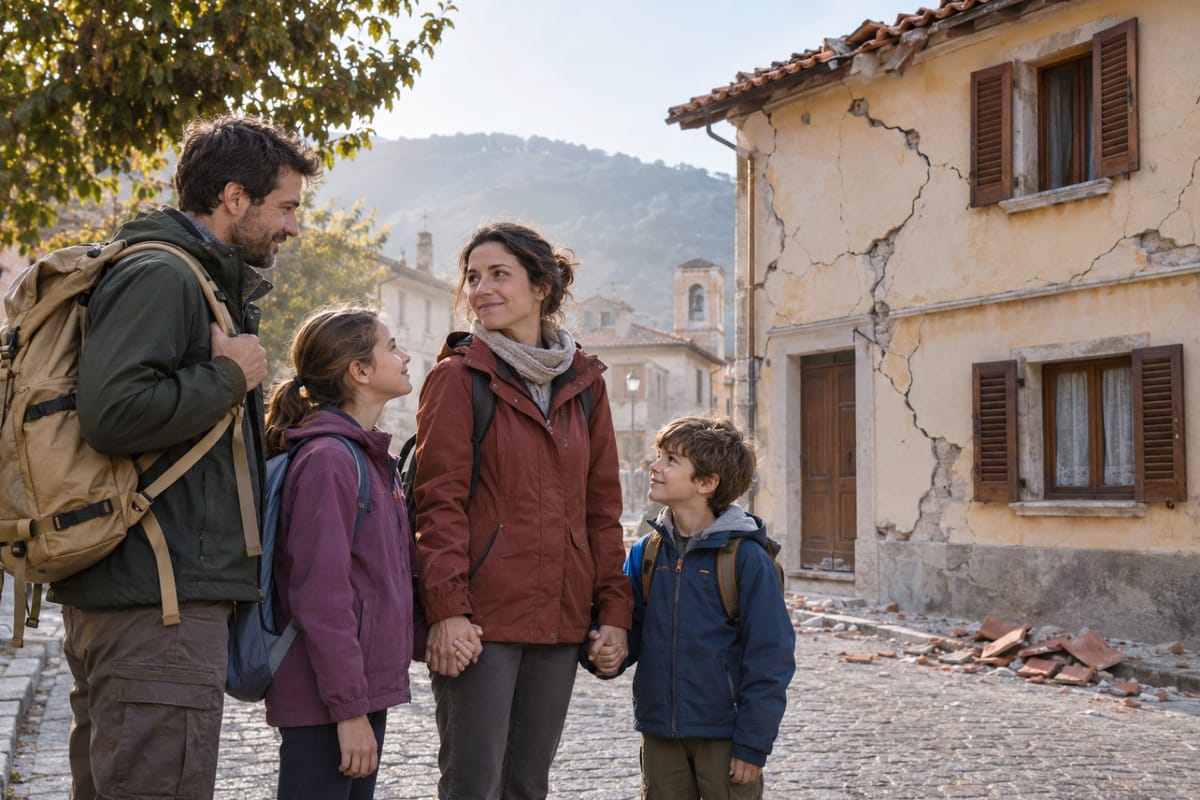
Europe on shaky ground: seismic activity is rising
The ground beneath Europe refuses to settle. Switzerland has just had a record year for seismic activity [Source: SED | Earthquakes in 2024, ETH Zurich], and noticeable tremors have shaken Austria [Source: Earthquakes in July 2025 (Austria), GeoSphere Austria] and Germany [Moderate earthquake near Freiburg/Lörrach (2024)]. Emergency preparedness is back on people's minds. Experts warn that when it happens, you'll have only seconds, and you can't afford to waste them on packing.
We tend to think of earthquakes as a danger for faraway countries such as Japan or Chile. Yet the events of 2024 and 2025 showed that Central Europe is no quiet zone either. In 2024 alone, the Swiss Seismological Service (SED) recorded around 2,300 earthquakes [Source: SED | Earthquakes in 2024, ETH Zurich], more than in any year since measurements began. Many of them were picked up only by sensitive instruments. Even so, events like the magnitude 4.4 earthquake in the Sihl Valley (June 2024) [Source: Swiss earthquake review 2024, RAOnline] and the tremors near Lörrach on the edge of the Black Forest (June 2024) [Source: Moderate earthquake near Freiburg/Lörrach (2024)] have left people across the DACH region (Germany, Austria and Switzerland) feeling uneasy.
Italy saw something more dramatic in June 2025. A magnitude 4.6 earthquake shook the Campi Flegrei (Phlegraean Fields) near Naples [Source: Strongest earthquake in Naples for 40 years (June 2025)], the strongest there in 40 years. All this geological unrest carries a warning for us:
We cannot control the forces of nature, but we can secure our survival through knowledge and the right equipment.
The reality: earthquakes don't wait
An earthquake almost never gives advance warning. It often starts with a low rumble, followed by violent jolts. In that moment, your reflexes and your preparation are a matter of life and death.
What to do DURING the earthquake
Based on international safety standards [Sources: Germany's Federal Office of Civil Protection and Disaster Assistance (BBK): "Earthquakes" and "What to do during/after an earthquake"; oesterreich.gv.at (Austrian Federal Ministry of the Interior, BMI): "What to do in an earthquake"; Swiss natural hazards portal: "What to do in an earthquake"] and expert guidance, these are the rules to follow:
Indoors:
- Stay calm: panic is your worst enemy
- Don't rush straight for the stairs or the lift (stairwells can collapse and lifts can get stuck)
- Take cover under a sturdy table ("Drop, Cover and Hold On")
- Keep away from windows, mirrors and heavy furniture that could topple over
Outdoors:
- Stay outside
- Find an open space, well away from buildings, trees, power lines and bridges
In a vehicle:
- Pull over somewhere safe (not under bridges or power lines)
- Stay in the vehicle until the shaking stops
The golden seconds: why preparation is everything
When the ground starts shaking, there's no time to hunt for a toothbrush or sort through your documents. You often have to get out in a split second. This is where many households fall down: they have no emergency kit ready to grab.
Safety experts strongly recommend keeping a packed "bug-out bag" (emergency backpack) ready in or near the hallway. A prime example of this kind of all-in-one solution is the ReadyKit emergency backpack. It was designed specifically to secure your survival in the critical first 72 hours after a disaster, so you don't have to worry about a packing list in the middle of the chaos.
What goes in an emergency backpack?
A look at how the ReadyKit emergency backpack is organised into modules shows what matters most in an earthquake:
1. "Escape" module (escape and rescue)
In an earthquake, doors can jam and the power grid can fail.
Essential tool:
- An emergency hammer with a glass breaker helps you free yourself from a trapped vehicle or through a blocked window
Light and protection:
- A head torch is essential, because power cuts are the rule rather than the exception
- Leather work gloves protect your hands from broken glass and debris while you clear obstacles
- A whistle lets you attract rescuers' attention if you're trapped under rubble. Shouting uses up too much energy and oxygen
2. "First aid" module (initial medical care)
Injuries from falling objects and broken glass are common. A basic first-aid kit often isn't enough.
As well as wound dressings and disinfectant spray, ReadyKit includes a rescue breathing aid. With it, you can give first aid to people who are injured or trapped under rubble.
Important: In an earthquake, FFP2 masks (included in ReadyKit) are about far more than protection from viruses. They are vital for survival because damaged buildings throw up huge amounts of dust.
3. "Tools and communication" module
After an earthquake, information is hard to come by. Mobile networks are often overloaded or down altogether.
- A wind-up radio with solar charging lets you receive official warnings, and it doubles as a power bank and a light
- A simple mobile phone with a long battery life (as included in ReadyKit) is more reliable than a modern smartphone that needs charging every day
4. "Water and food" module
Pipes burst and water becomes contaminated.
- A portable water filter (0.1-micron pore size) makes water from puddles or streams drinkable by removing 99.9% of bacteria
- Energy bars with a long shelf life (10+ years) provide the calories you need for 72 hours, with no cooking required
Expert tip: Don't leave packing your emergency kit until disaster strikes. The stress makes rational action impossible. A pre-packed system like ReadyKit is a life insurance policy you can physically pick up.
After the earthquake: the danger isn't over
Even once the main shock has passed, seismologists urge caution:
Aftershocks: Expect further tremors in the hours and days that follow. They can bring down buildings that are already damaged.
Check the utilities: Turn off the gas, water and electricity until they have been inspected. If you smell gas, air the rooms straight away. Don't use lighters.
Emergency number: If there are injuries, fires or water damage, call the fire service on 112.
Hygiene: Once the sewers are damaged, hygiene becomes a real problem. For this, ReadyKit includes folding emergency toilets and disinfectant to help prevent outbreaks of disease.
The takeaway: act now instead of reacting later
The seismic data from Europe in 2024 and 2025 makes one thing clear: the ground we live on is not safe. You can't prevent an earthquake, but you can drastically reduce the impact it has on you.
Being prepared, mentally by knowing how to react and practically with a professionally packed emergency backpack, significantly improves your chances of survival and those of your family.
Safety doesn't happen by chance. It's a decision you make.
The information in this article is based on current data from seismological services and specialist literature on emergency preparedness.
Further reading:
- Book: Savin, Sergej. (2018). "Klimakatastrophe: Was tun?" ("Climate catastrophe: what can be done?") Minsk, "Colorgrad" 2018
ISBN 978-985-596-115-5 - EMSC (earthquake event page, Slovenia)
- USGS (earthquake event page, Greece)
- EMSC (event page, Turkey–Syria border region)