Snow storm preparedness in the Allgäu: frost, ice and power cuts
An official frost warning is in force for the Allgäu, and the first snow is lying on higher ground. Here is what authorities recommend on ice, roof avalanches, heating and supplies.

Frost in the Allgäu, first snow on higher ground
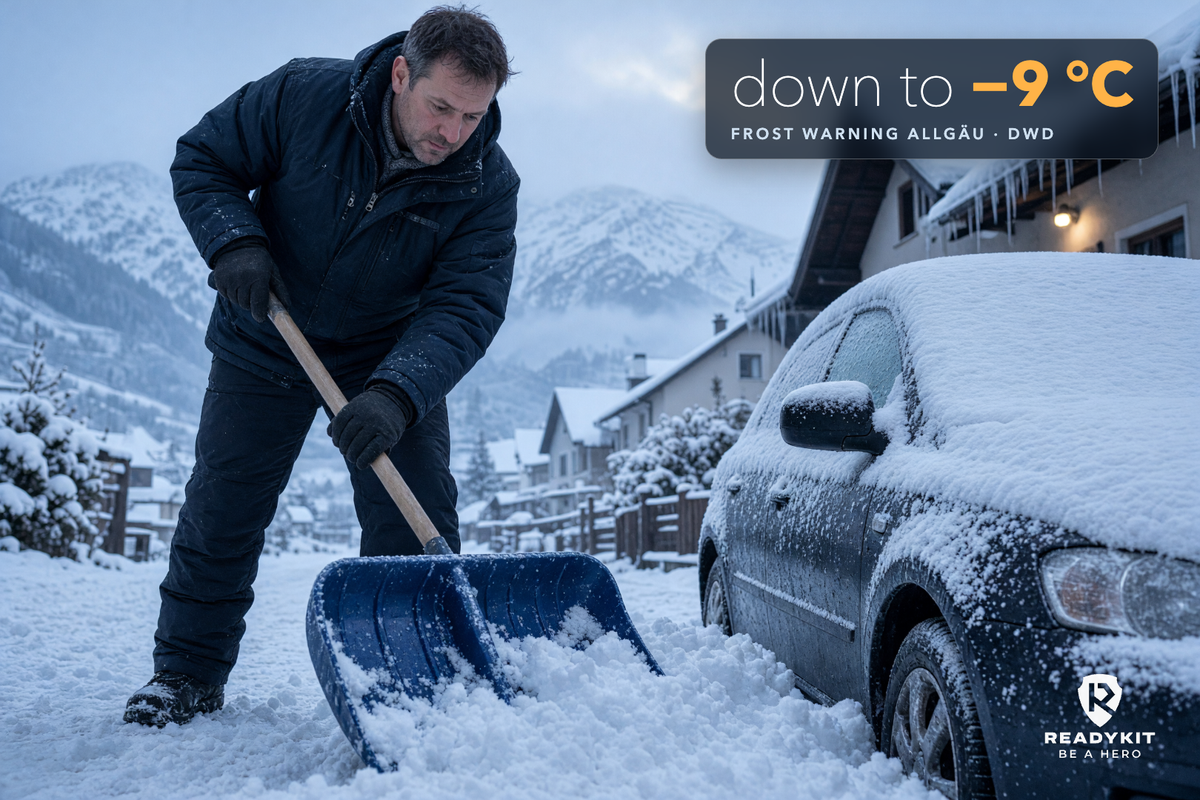
Winter is arriving. The German Weather Service (DWD) describes the final week of November as cold, and wintry in places: daytime highs around freezing, moderate night frosts in some areas, and the first snowfalls in parts of the country. On Sunday, and overnight into Monday, a few centimetres of fresh snow fell from the southern Black Forest to the Alps. According to the DWD, the most fell in the High Black Forest and on higher ground in the Oberallgäu. Around Oberstdorf there is a continuous cover of snow.
For the Allgäu itself, the DWD warning table for Bavaria (as of Monday 23 November, 22:10) lists an official frost warning. It covers the districts of Lindau (Bodensee), Oberallgäu and Ostallgäu, from 17:00 on Monday until 12:00 on Tuesday 24 November. Moderate frost between -5 °C and -9 °C is expected. That table does not list a snowfall warning for these districts. The sources therefore give no figure for how much snow will fall in the Allgäu, so this article does not state one.
What this means for you
This is not a state of emergency. It is a good moment to go through your winter routine. The DWD warning situation report (13:33) gives, overnight into Tuesday, widespread light to moderate frost between 0 and -8 °C, with isolated readings lower still, and a risk of ice in places where wet surfaces freeze over. Overnight into Tuesday there is dense fog in places, especially from the west through to the south, with visibility under 150 metres in some of those areas. Tuesday stays frosty well into the day.
In Switzerland, the mountains show how uneven an early winter can be. According to the Institute for Snow and Avalanche Research (SLF), precipitation kept falling in the west and north through the week of 16 to 20 November. Especially in the west, substantial amounts of fresh snow built up. There, the avalanche danger rose to level 4 ("high"), and some spontaneous avalanches were reported. On 20 November the avalanche bulletin warned of level 4 in places in the west, and otherwise of widespread level 3 ("considerable") in the north and west. Whether level 4 was reached everywhere that day cannot, the SLF says, be judged with confidence for every area. In the east and south, by contrast, there was still usually far too little snow at the end of the week for snow sports off pistes covered with artificial snow (SLF AvaBlog).
Germany's Federal Office of Civil Protection and Disaster Assistance (BBK) names typical winter risks: heavy snow loads that can endanger the structural stability of buildings, and heavy snowfall and icing that can damage power lines (BBK: cold and snowfall). The Swiss Federal Office for Civil Protection (BABS) writes, in its Alertswiss blog, that after several heavy snowfalls in a row the snow load on roofs can become large even in the lowlands, and on pitched roofs it can set off roof avalanches.
How to act in snow, ice and frost
Beforehand
- Heed weather warnings for heavy snowfall and ice. If you can, stay at home then. With a stock of food and drink, you can skip the shops when warnings are in force (BBK).
- Install a warning app. The NINA warning app (Germany) includes weather warnings from the DWD. You have to subscribe to places or districts yourself. If you do not, you will not get a warning on your phone. The BBK suggests entering your home and your place of work or training. You can use the app without providing personal data.
On the move and at home
- Heavy snowfall and ice can become dangerous for everyone, on foot, in a car and on a bicycle. Be careful, so you avoid accidents and falls. If you witness an accident in which people are injured, give first aid and call the emergency number (BBK).
- Snow avalanches can break away from house roofs, and icicles often hang from gutters and can snap off. The BBK advises you to keep a safe distance from pitched roof surfaces. During prolonged snowfall, roofers or the fire service should measure the snow load and clear the roof. Never clear it yourself. The BBK advises against that because of the risk of slipping and of collapse, and clearing a roof improperly can put people in mortal danger.
- Tell children that icy, hard snow can cut their hands when they play, and that hard snowballs can cause serious injuries (BBK).
- Frozen water: the BBK recommends stepping onto ice only once there is an ice layer of 15 centimetres, and only if the municipality has officially opened it. Stepping onto other surfaces is life-threatening, the BBK says. Watch for warning signs, and never let children play alone on frozen water. The ice rules of the German Life Saving Association (DLRG), which the BBK sets out on the same page, add this. Never go onto the ice alone. You should not step onto a lake until the ice is 15 centimetres thick, and not onto flowing water until it is 20 centimetres thick. If the ice crackles and cracks, get off at once. If you notice someone breaking through the ice, call the fire service on 112.
In the mountains
The SLF opened the bulletin season on 15 November. If you are out in the Swiss mountains in winter, you will find the current danger level in the SLF avalanche bulletin. The AvaBlog records that spontaneous avalanches were possible even when there was little snow.
Emergency numbers
In Germany the emergency number is 112 (BBK). In Austria, the portal oesterreich.gv.at lists the fire service on 122, the police on 133, the ambulance service (Rettung) on 144, the European emergency number 112, mountain rescue on 140 and the gas emergency (Gasgebrechen) on 128, plus further numbers. Our sources contain no emergency numbers for Switzerland, so none are named here.
At home: warmth, light and supplies
If the power goes off during a frost, you will notice it first at the fridge, the cooker, the lights and the heating. The BBK guide "Preparing for crises and disasters" describes what helps then.
Food and drink
The BBK recommends being able to supply yourself for ten days if possible, but also says that a supply for at least three days already helps a great deal. For water, the BBK calculates an ideal of 2 litres per person per day, of which 0.5 litres is for cooking. Long-life food that does not need refrigerating is practical, as is food you can eat without a cooker. The Swiss authority calculates differently. The Alertswiss blog recommends food for about a week and 9 litres of water per person for three days, which is 3 litres a day for drinking and cooking. If you live in Germany, the BBK figure applies. If you live in Switzerland, the BABS figure helps.
Warmth
Without power, the heating may not work either, and rooms can cool down quickly. With warm clothing, blankets and sleeping bags you can get by for a while, the BBK says. Keep windows and doors closed, but air rooms regularly, briefly and with the windows wide open. Gas heaters, ethanol fireplaces or paraffin stoves that are approved for indoor use work without power. Take care when cooking and heating without power, including with an open fire indoors. If something burns with too little oxygen, carbon monoxide can form. Carbon monoxide poisoning is life-threatening. The BBK advises using only devices approved for indoor use, and ideally installing carbon monoxide alarms that have been tested and approved. Camping stoves with a gas cartridge, and gas or charcoal barbecues, should be used only outdoors.
Information
During a power cut, or if the mobile network fails, many warning channels do not work. Radio stations keep working. Car radios, wind-up radios and battery radios run without mains power. The BBK also recommends a charged power bank and a list of important phone numbers on paper.
Light and everyday things
A torch with spare batteries, candles and a lighter are on the BBK checklist, and so are personal medication and a folder of important documents. The Austrian list names, among other things, cash, ID and an overview of the most important contacts. Those items are on the BBK list as well.
A backpack if you have to leave
The BBK recommends an emergency kit kept within reach: warm clothing, rain protection and, ideally, sturdy shoes, a change of clothes, important documents, a charged power bank, first-aid supplies, personal medication and hygiene items, long-life food, a refillable water bottle and cash. In the configurator you can build your own emergency backpack for what you need, including a wind-up radio. If you would rather not pack it yourself, it is also available pre-packed for 72 hours.
In closing
For the Allgäu, the frost warning runs until Tuesday midday. It only takes a few minutes to sort a warning app, a torch and a water supply, and that helps with frost, ice and a power cut. How the weather develops from here is shown by the current DWD warnings.
BE A HERO – Because your family is counting on you.
Sources
- A cold, partly wintry final week of November (Topic of the day, 23 November 2026), German Weather Service
- Warning situation report for Germany, 23 November 2026, German Weather Service
- Bavaria warning table, as of 23 November 2026, 22:10, German Weather Service
- Preparedness and what to do in cold and snowfall, BBK
- AvaBlog, 16 to 20 November 2026, SLF
- Know the hazards: heavy snowfall, Alertswiss (BABS)
- Emergency supplies: questions and answers, Alertswiss (BABS)
- NINA warning app, BBK
- Preparing for crises and disasters, BBK
- Self-protection in a disaster, the basics, oesterreich.gv.at