Flood preparedness: what the Bantry floods in Ireland show
Overnight into 22 November 2026, heavy rain flooded the centre of Bantry in Ireland. Around 20 shops were hit, even though some had put up flood barriers. Here is what the authorities in Ireland, the UK and Germany advise.

Looking back: the night of 21 to 22 November in Bantry
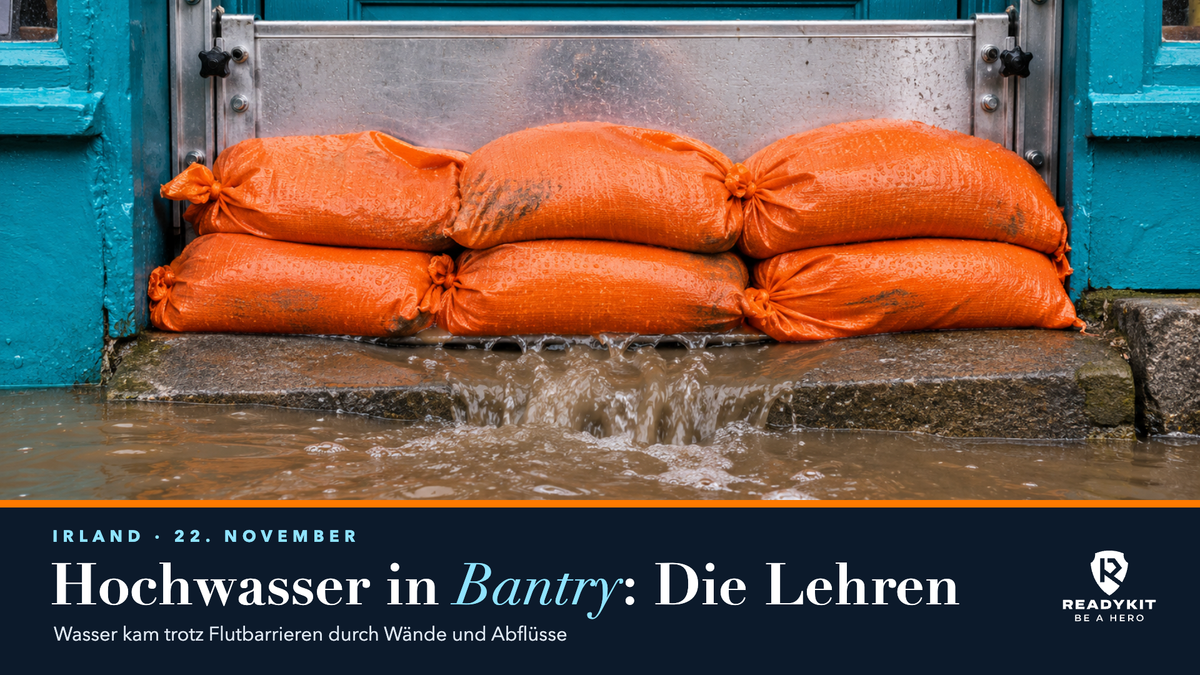
In the early hours of Sunday 22 November 2026, heavy rain flooded the centre of Bantry in County Cork, Ireland. According to Cork County Council, The Square, New Street, Main Street and Barrack Street were hit. The Southern Star reports more than 20 affected businesses and 16mm of rain between 1am and 2am, while the Echo says up to 20. The fire service and the council were called out at around 2am, and the clear-up began in the morning. Our thoughts are with everyone affected.
We do not know what the situation is now. This article looks back at 22 November and asks what it means for your own home.
Why the water got in despite the barriers
Bantry shows that water does not only come in through the front door. Councillor Danny Collins told RTÉ that some businesses had flood barriers at the front of their premises, but the water still came through the walls. The Southern Star, in its report on the council's offer of help, says that despite several barriers going up, water came in through floors, walls and toilets. Senator Noel O'Donovan told the Southern Star that the shops flooded through a "culvert" (a drainage channel that cannot take enough water), and that inside, the water came up through walls, toilets and drains. Councillor Danny Collins told the Echo: "Water came in from the back of a lot of places". He said the buildings are so old that the water rises through the floor and the back walls.
According to the council, two things coincided: intense rain overnight and high tide. The council had put pumps and sandbags in place and contacted the local business organisation before the Met Éireann Status Yellow warning came into effect. According to RTÉ, the warning ran for Cork from 10pm until 8am and mentioned difficult travelling conditions and localised flooding.
The effects on businesses were concrete. A baker told RTÉ that there was up to 8 inches (about 20cm) of water in his bakery by 3am. The fridge and dishwasher did not work at first, and flour, stock and packaging had to be thrown away. Collins said business owners were waiting to see whether their electrical equipment still worked.
Some background: according to the Echo, this was the fifth flood in the area in six years. Councillor Collins gives 2032 at the earliest as the start of construction for the flood relief scheme led by the OPW (Office of Public Works). Senator O'Donovan gives the fourth quarter of 2027 as the current timeline for the culvert works. These are statements by politicians, and we do not assess them.
Could this happen where you live?
Not only near rivers. The UK government's gov.uk says flooding can also happen where you do not live or work near a river or the sea. Germany's Federal Office of Civil Protection and Disaster Assistance (BBK) asks whether your home is vulnerable to heavy rainfall, and points out that many municipalities publish heavy-rain hazard maps online. Ireland lists rivers, the sea (coastal and tidal flooding), intense rainfall and groundwater as sources of flooding. In Bantry, intense rain and high tide came together.
If you are travelling to Ireland: Met Éireann publishes weather warnings via RTÉ (radio and TV), many local radio stations and met.ie (gov.ie).
What to do
Wherever you are, follow the advice of that country's authorities. The points below come from the Irish government (Office of Emergency Planning, Department of Defence), from gov.uk and from the BBK.
Before a flood
- Check whether your home is at risk of flooding: ask neighbours and your local authority, or look at the hazard maps (gov.ie, BBK).
- Think about where water could get into your home, and assess the risk to bedrooms on the ground floor or in the basement (gov.ie).
- Make a flood plan for your household. The Irish site says that preparing one is "well worth the time" (gov.ie).
- Ask your insurer whether flood damage is covered (gov.ie).
- Agree emergency and danger signals with your neighbours in case phones and mobile networks go down, and work out who in the household does what (BBK).
- Think about people who are ill or need help, and about pets: where can you go, and how will they get there (BBK)?
- Keep an eye on warnings: in Germany through the NINA warning app, radio or the internet (BBK). In England, the Environment Agency usually issues Flood Warnings 30 minutes to 2 hours before flooding, and Flood Alerts usually 2 to 12 hours before (gov.uk). The window can be short.
During a flood
Indoors:
- Move valuables above flood level or upstairs, and put sandbags at every opening where water could get in (gov.ie).
- Turn off gas and electricity. The Irish site says this without qualification. gov.uk adds "if it's safe to do so", and says not to touch an electrical switch if you are standing in water. The BBK points to the risk of electric shock and advises switching off appliances in rooms that could flood, and if necessary the power completely at the fuse box. Pay particular attention to the gov.uk warning: do not switch anything off if you are standing in water.
- Keep warm clothes, wellies and medication to hand, and be ready to evacuate, possibly to an emergency centre (gov.ie).
- Follow the instructions of the authorities and emergency services (gov.ie, gov.uk, BBK).
In the car and outdoors:
- Do not walk or drive through flood water (gov.ie, gov.uk, BBK). According to gov.uk, the water can contain sewage and can hide rubbish, debris, uneven roads and pavements or broken drain and manhole covers.
- Move your car to higher ground if you can (gov.ie).
- Avoid contact with flood water, as it may be contaminated. If you have to cross shallow water, take care: manhole covers may have come off, and there may be obstacles under the surface that you cannot see. Never try to swim through fast-flowing water (gov.ie).
- The BBK also advises moving your vehicle out of at-risk garages and car parks in good time. Underground car parks can become deadly traps when there is a risk of flooding. If your car is standing in water that comes up over the wheels, have it towed.
- Help others, but do not put yourself in danger (BBK, gov.uk).
- In Great Britain, call 999 if there is immediate danger, according to gov.uk.
Basements: preventing flooding and responding properly
The BBK says: do not stay in the basement while a flood is under way, as it is life-threatening. The BBK also recommends:
- Check the backflow valves in your basement before the water has risen.
- Seal windows, doors and drain openings. To protect them, the BBK advises getting sandbags, shuttering boards, waterproof plywood panels and silicone.
- Clear out basement rooms that groundwater could get into or that could fill with water.
- Move valuable furniture and equipment such as computers to upper floors, and anchor your heating oil tank against buoyancy, for example to a wall or with ballast.
- Secure hazardous substances and chemicals against the water.
For outside, the Irish authorities also advise: take chemicals and fuel out of the garage so they do not get into the water, weigh down manhole covers with sandbags or heavy objects, close the valves on propane tanks, oil drums and other fuel containers that supply your home through pipes, and unplug outdoor equipment (lighting, pond pumps, filters). In the longer term, they advise considering whether structural measures are required, such as retrofitting flood barriers, sealing basements or buying floodgates.
On help after a flood in Ireland: the council points affected businesses to the Emergency Humanitarian Flooding Scheme, which the Irish Red Cross administers on behalf of the government. For private households, gov.ie lists the Emergency Response Payment (Community Welfare Service), short-term financial support for people whose homes have been damaged and who cannot meet the cost of essentials themselves. In Great Britain, gov.uk advises contacting your local council for emergency accommodation if your home is uninhabitable after a flood. You will not find a guide to cleaning up and drying out here. The BBK has a separate page on that (in German).
Preparing at home
The BBK lists what should be in the house for a flood: enough food and drinking water, a battery-powered or wind-up radio, a torch, a camping stove and a camping toilet. Add a folder of documents and an emergency kit. When a Flood Alert is in force, gov.uk advises having your insurance documents and medication ready. The BBK also reminds you about insect repellent, in case mosquitoes and other pests spread through the house once the water goes down.
If you would like help with your emergency kit, there are two routes. In ReadyKit's configurator you build your backpack yourself from modules. Or you can choose the pre-packed emergency backpack, which is designed for 72 hours of self-sufficiency. A wind-up radio is one of the options the BBK lists, and the electronics module includes a wind-up radio with an SOS alarm and LED. The electronics, hygiene items and sleeping module come in waterproof packaging, and there are waterproof bags for documents and spare clothes. The backpack itself is water-repellent, but not waterproof.
The takeaway
A flood barrier at the door is a start. Bantry shows that it pays to watch the walls, floors and drains as well, and that your plan should be in place before the warning comes.
BE A HERO – Because your family is counting on you.
Sources
- Bantry businesses 'waiting and praying' after flooding, RTÉ (22.11.2026)
- Breaking: Bantry hit by flooding again as 16mm of rain fell, Southern Star (22.11.2026)
- Bantry counts the cost of 20 businesses flooded – again, Echo (22.11.2026)
- Council say help is at hand for Bantry businesses affected by flooding, Southern Star (22.11.2026)
- Flooding advice, Department of Defence / Office of Emergency Planning (gov.ie)
- Advice in a flooding emergency, Office of Emergency Planning (gov.ie)
- What to do before or during a flood, GOV.UK
- Flood alerts and warnings: what they are and what to do, Environment Agency (GOV.UK)
- What to do in a flood, BBK, in German
- Being well prepared for floods, BBK, in German