Declaration that will shake science | Dr Egon Cholakian | Part 2
The root cause of the climate anomalies: an astronomical cycle the whole solar system enters every 12,000 years, the illusion of safety humanity lives in, the 24,000-year cycle of peak disasters the Earth has been in since 2024, and the Siberian magma plume.

The great Permian extinction 2.0: history repeats itself 250 million years on
In the first article we looked at the rapid rise in climate anomalies: unusually large hail smashing through roofs, tornadoes on new paths, megastorms and atmospheric turbulence. The main takeaway was that all existing climate models are out of date and no longer explain what we are observing. Humanity is facing phenomena that were not expected for another 100 to 150 years.
The root cause of the climate anomalies
The rapid rise in the frequency, intensity and destructive power of atmospheric phenomena has a fundamental cause. Before Dr Egon Cholakian moves on to the scientific explanation, he asks the audience to watch a short video overview made by volunteers from the ALLATRA movement.
It brings together facts and eyewitness accounts showing what has happened in the Earth's atmosphere and hydrosphere since 2024, and what the consequences have been. Everyone should watch this video. Wherever in the world people live, they need to understand that nobody is safe from events like these.
The point is not to spread fear but to help people prepare, so that they are not caught off guard.
The illusion of safety
Many people live with an illusion of safety in the comfort of their homes, simply because disaster has not yet reached their region. But for millions of people around the world, it is already here. It has destroyed their homes, taken the lives of their loved ones and robbed them of their future. Just because people haven't seen it with their own eyes doesn't mean it isn't happening. It means only one thing: the front line of climate disasters hasn't reached them yet. Sadly, that is only a matter of time.
The 12,000-year astronomical cycle
The first and most important cause of the natural anomalies now appearing in all of the Earth's shells is an astronomical cycle that the entire solar system enters every 12,000 years.
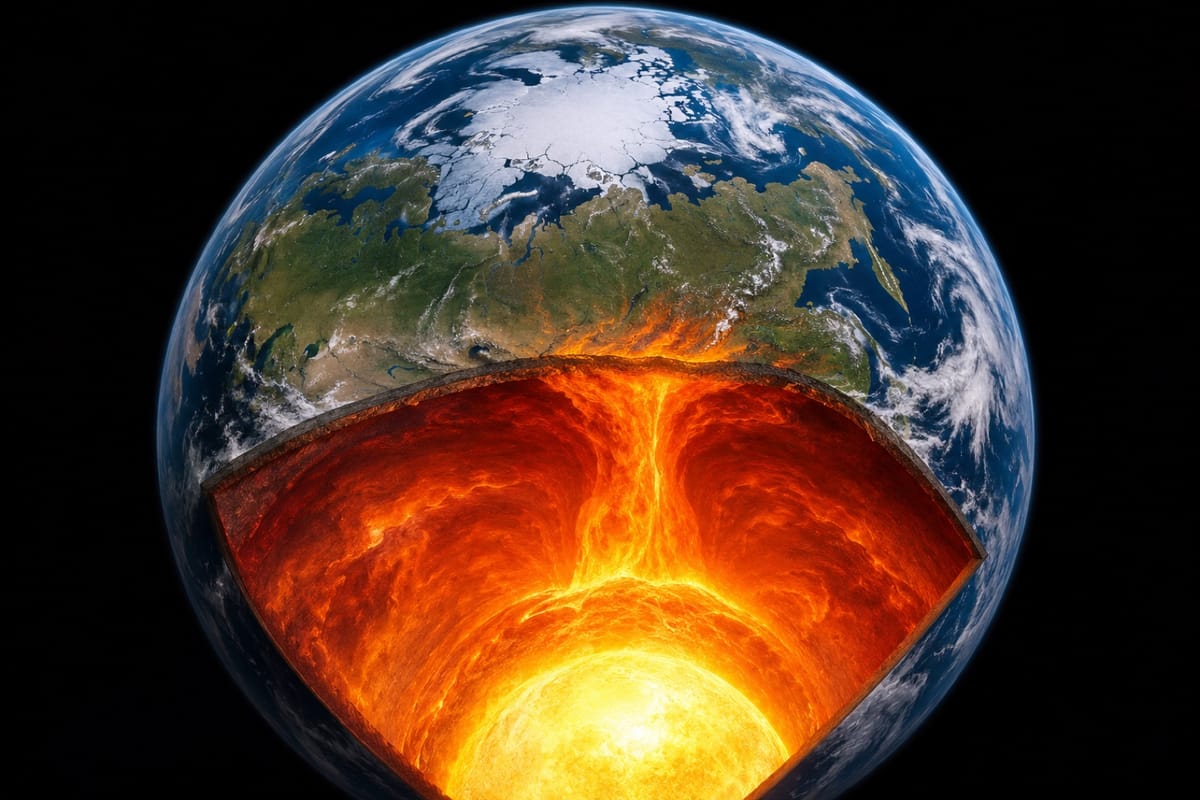
Dr Egon Cholakian asks us to picture the Earth as a huge ball with another, very hot ball at its centre: the Earth's core. Every 12,000 years this inner core is exposed to an additional cosmic influence in the form of extra energy. You could compare it to putting extra voltage through an electric heater.
This "heating" affects not only the Earth but also the other planets of the solar system, and even the Sun itself. The proof that this external cosmic influence exists is the activation of the Earth's interior and the rise in anomalies in the various shells of every object in the solar system that has a core.
An influence of unknown physical nature
The physical nature of this external cosmic influence is still unknown, because humanity has not yet managed to detect the influence itself. Scientists can see its effects, though. Planets long regarded as "dead" are now showing signs of geodynamic activity, and significant changes are taking place in all of the Earth's shells as well. Everything points to surplus energy coming in from outside, heating the planets from within and activating tectonic, volcanic and electromagnetic phenomena.
The pan of milk analogy
This external energy heats the Earth's core even further. Picture turning up the flame under a pan of milk on the hob, with a glass lid on top. In the same way, molten material deep inside the Earth moves more vigorously, and magma actively rises closer to the surface.
Just as the milk in the pan climbs towards the lid, magma rises from the depths of the Earth's mantle towards the crust and tries to break out, much like milk threatening to spill out from under the lid.
At first, the milk pushing up towards the lid builds pressure and makes the lid rattle. Likewise, magma approaching the crust builds pressure that causes tectonic vibrations, which show up as more frequent earthquakes.
Then the milk starts to lift the lid and escape in small jets of steam and droplets. This can be compared to individual volcanoes becoming active, with columns of steam and local outflows of magma.
In terms of physics, what happens in a heated pan of milk closely resembles what is currently going on inside the planet.
The 24,000-year cycle of peak disasters
Heating from within sets off a whole chain of consequences on the planet. More heat escapes from the depths, the ocean warms, the temperature and humidity of the atmosphere rise, and earthquakes become more numerous and more frequent, as do bursts of volcanic activity.
Studies of ancient rock and ice layers, which store information about past events like an "archive", show that such periods of activation of the Earth's interior came round regularly, roughly every 12,000 years. Every 24,000 years, these disasters were even more powerful.
This happened because every 24,000 years a considerably larger amount of external cosmic energy reached the Earth's core. That led to more intense melting of the mantle and caused even stronger earthquakes, volcanic eruptions, tsunamis, floods and hurricanes.
The current disaster cycle
According to geological data, cataclysms this powerful last struck the planet around 24,000 years ago. This means humanity has now entered a period with more devastating consequences than the one 12,000 years ago. It is the reason behind the growing number and strength of cataclysms, and every other factor comes on top of it.
The ocean's thermoregulation is failing
The next cause, which amplifies the already frighteningly powerful 24,000-year cycle, is the disruption of a central mechanism in the Earth's cooling system: the ocean's ability to regulate heat. This disruption has been caused not only by plastic pollution in the ocean but also by the breakdown of that plastic into micro- and nanoplastics. Nanoplastics in particular are an anthropogenic factor that reduces the thermal conductivity of seawater.
As a result, heat that cold ocean water used to draw away from the lithospheric plates is no longer being removed as efficiently. Imagine a large amount of sand suddenly getting into a car engine's cooling system: the engine would overheat because the system could no longer get rid of the heat properly. Something similar is happening to the ocean. Nanoplastics impair its ability to cool the Earth's crust, which means excess heat keeps building up in the depths.
The Siberian magma plume
Two additional factors make the situation even worse. The first is the Siberian magma plume (also called a mantle plume).
Dr Cholakian has explained this phenomenon several times in earlier addresses, but he assumes many people are hearing about it for the first time, so he briefly sums up the essentials.
Most people know what a volcano is: a vent or fissure in the Earth's crust through which magma from the upper layers of the mantle reaches the surface. Volcanoes are usually local and linked to the boundaries of tectonic plates.
A magma plume is a fundamentally different phenomenon. It is an enormous column of glowing material rising from deep layers of the Earth's mantle, possibly even from the boundary between the mantle and the core. A plume is incomparably larger than any volcano.
The scale of the threat
The Siberian magma plume measures 2,500 to 3,000 km across, comparable in size to the whole of Australia. It forms far deeper than volcanoes do, hundreds or even thousands of kilometres below the surface.
A volcanic eruption is a local event, whereas the activity of a plume can trigger far-reaching geological changes and global disasters.
To put it in perspective: if a volcano is a single fountain in a park, a plume is a city's entire water supply system, feeding many such fountains. Or, to take another analogy, in terms of energy a volcano is like a barbecue for grilling steaks at the weekend, while a plume is like a nuclear explosion of colossal power.
Even compared with the famous Yellowstone supervolcano, which is already regarded as a serious threat, the Siberian magma plume poses an incomparably greater danger. It is potentially capable of releasing a volume of magma 1,000 times greater than the largest possible eruption at Yellowstone.
What's coming in part 3?
But humanity has one last chance. In part 3 you'll learn about the revolutionary technologies of ALLATRA's scientists, which protected large areas from disasters for ten years and created a statistical paradox that science cannot explain. Most importantly, we will reveal the details of a pioneering experiment in synthesising matter from the vacuum, which could change our understanding of the origin of the universe and give humanity the technologies it needs to survive. Stay tuned for a scientific breakthrough that turns everything we think we know about the laws of modern physics on its head and lets us look at physics from an entirely new perspective.